

Friday, you close the terminal. The balance moved up a touch, and you would struggle to say whether the week was any good. Four trades, and nothing alike about them: two held exactly as planned, one where you widened the stop the moment it went against you, and a position opened late in the session because nothing else had shown up. The balance treats all four as the same kind of event.
A trading score exists to separate what the balance merges.
What your balance counts, and what it never records
Two winning trades of the same size are not worth the same thing. The first came off your setup, with an invalidation level written down before the order went in, and you exited where you said you would exit. The second you took because the morning had been empty and you wanted something on the books. It worked. It paid you, and it taught you, in passing, that stepping outside the plan goes unpunished.
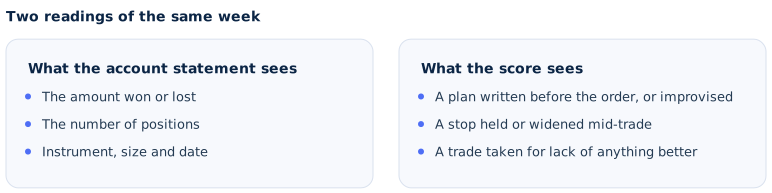
An account statement adds up. It has no way of telling a result earned by process from a result handed to you by luck, and it will rank a clean trade that lost below a sloppy one that won. Over a single session, that gap is harmless. Over a quarter spent learning, it decides which habits you keep.
What one number costs you, and what it buys
Every score pays the same price: dozens of observations crushed into one value. Look at it on its own and you won't know whether it slipped because of three entries taken off-plan or one panicked exit. The detail is gone.
What you get back is comparability. Three weeks side by side are unreadable when each takes twenty lines of commentary; they become readable when each one fits into a single marker. The score doesn't replace the reread. It tells you which week deserves one.
The signals that move the number
The number doesn't come from nowhere. It aggregates things you can observe in your own trades, without knowing anything about the market:
- Plan adherence — were the entry level and the invalidation written before the order, or decided while the trade was running?
- Risk consistency — does size follow a rule, or your confidence that morning?
- Exit discipline — stops widened, targets abandoned halfway, positions cut on a single candle.
- Selectivity — how many positions belong to none of your setups?
- Journal quality — a trade with no reason recorded is a trade you will never be able to reread.
None of these needs a market figure to be judged. They all sit in your own rows, and you could score them by hand if you had the patience.
The direction matters more than the level
The absolute level of a score says very little on its own; you have nothing to compare it against except yourself. The direction says a great deal. A number sliding for three weeks while the balance climbs tells you something precise: you are being paid for habits that will not hold. A number rising through a losing run says the opposite — you are executing cleanly while the method goes through a rough patch, which is exactly when the urge to change everything is strongest.
Read the slope. And read it over a stretch that holds enough trades for chance to stop driving it.
Tracing the score back to the trade that moved it
A score you can't open is decoration. The path is always the same: find the stretch where the number drops, filter your trades over that stretch, look for the shared ingredient, then reread what you wrote at the moment of entry. Often the pattern is one sentence long — three trades taken in the same half hour of the day, or all of them on the same instrument, or every one of them straight after a loss.

This is where a properly kept trading journal and the score work together: one flags, the other explains. Without the entries underneath it, the number tells you your mood and nothing else.
What no score will ever tell you
It doesn't tell you whether your method has an edge. Flawless execution of something that doesn't work will produce a tidy score while the account goes the other way, and the score will keep applauding the whole time.
It doesn't tell you whether to take the trade currently on your screen either. Scores look backwards, at what you already did, which is the only material they have.
And it doesn't replace a target. A score places you; a written goal points you somewhere. Deciding that no position goes on without an invalidation level written first is a decision, not a measurement — the score only reports, afterwards, whether you kept it.
Where the trades you score come from
A score is only as good as what you feed it. In FixyTrade the trades arrive three ways, and most people end up using more than one.
The MetaTrader 4 and 5 route runs through the terminal's FTP publisher: the account pushes its trades across on its own, with the current month as the limit — the terminal doesn't transmit further back than that. For anything older, a CSV export from whatever platform you trade on covers the gap. And a trade taken somewhere that exports nothing at all goes in by hand, one line at a time.
A common arrangement: CSV for the history, the terminal connection so the running month fills itself, manual entry for the odd one out. From there the trading score has something real to work on.
What you do with it on Monday morning
A score you read and close changes nothing. What changes it is one rule at a time. You look at the week, you find the ingredient, and you turn it into a single instruction for the next five sessions: no order without an invalidation level written first. Not three rules. One.
You open the score again on Friday. If it moved, you know why. If it didn't, the problem sits somewhere else and you have eliminated a hypothesis — which is also a result, and a cheaper one than finding out through the account.